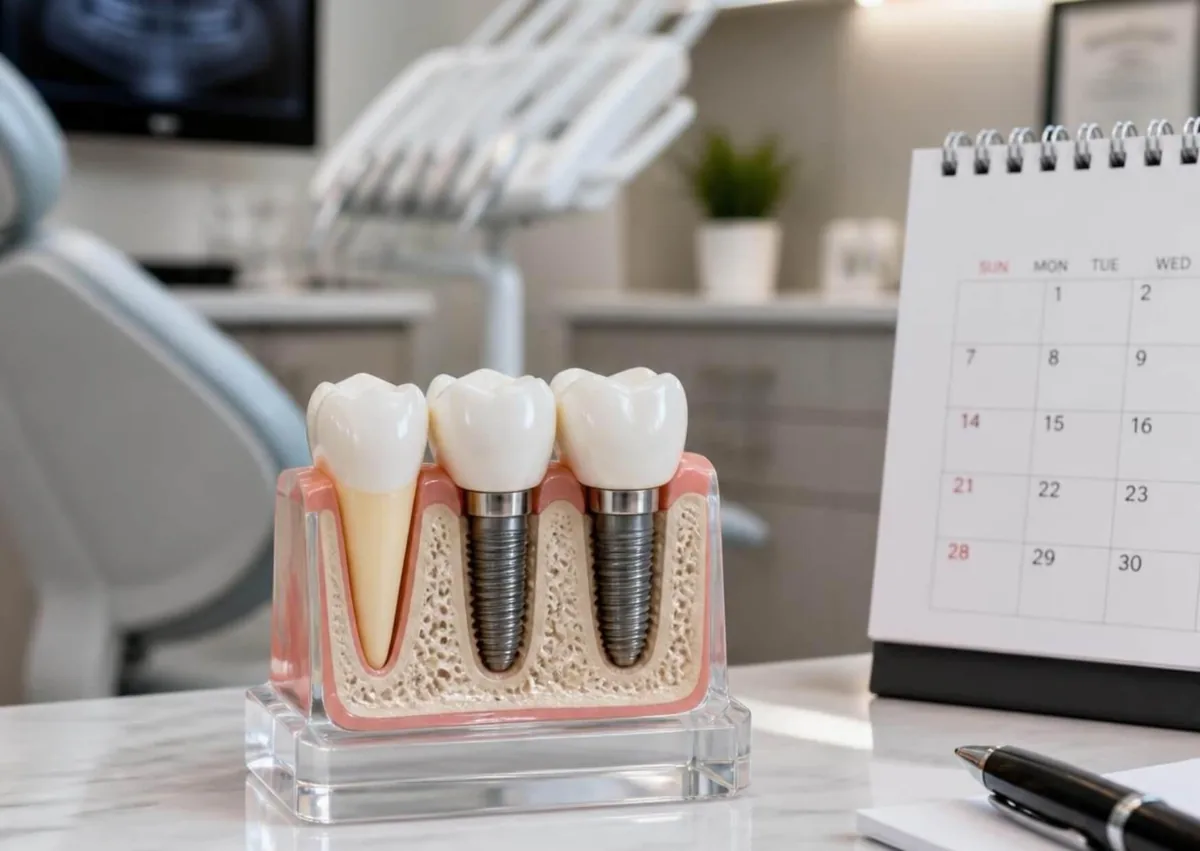
A tooth implant usually takes three to nine months from evaluation to final crown, though some cases move faster and others take a year or longer. Most of that time is healing time in the bone and gums, not time spent in the dental chair. A typical treatment timeline depends on the condition of the tooth, the amount of available bone, and whether any preparatory treatment is needed.
If the area is healthy and ready, treatment may move quickly. If the tooth still needs to be removed, the site needs a bone graft, or healing is slower than expected, the process takes longer. If you are comparing timing along with budget, it may also help to review the cost of dental implants as you plan.
If you’re weighing options for replacing a missing tooth or concerned about treatment time, dental implants offer a durable, natural-looking solution tailored to your priorities. Oasis Smile Studio in High Point, NC provides clear timelines and patient-focused planning so you can make informed choices about care.
Implant treatment happens in steps, not in one long procedure. The implant is a small post, usually titanium, placed in the jawbone to support a replacement tooth, and the final crown is part of restorative dentistry.
|
Stage |
Common Time Frame |
What Happens |
|---|---|---|
|
Exam and planning |
One or more visits |
The dentist checks the tooth, gums, bone, bite, and health history |
|
Tooth removal, if needed |
One visit |
The damaged tooth is removed, sometimes with bone grafting |
|
Healing after removal or grafting |
About 2 to 6 months |
Bone and gum tissue mature before implant placement |
|
Implant placement |
One visit |
The implant is positioned in the jawbone |
|
Bone integration |
About 2 to 6 months |
Bone attaches to and stabilizes the implant |
|
Crown preparation and placement |
Several weeks and a few visits |
The final tooth is designed, adjusted, and secured |
Some of these steps can overlap. In selected cases, a dentist may remove a tooth, place a graft, or insert an implant at the same visit if the site is stable and the risk of infection is low.
The longest part of implant treatment is usually the healing phase after placement. During this time, the jawbone bonds to the implant surface in a process called osseointegration.
This bond is what lets the implant handle chewing pressure later. Even when the gums look healed, the deeper bone may still be maturing.
That waiting period can feel frustrating, especially when the space shows when you smile or chewing feels awkward. A temporary tooth may be possible, but it has to be designed carefully so it does not put too much pressure on the healing area.
Bone quality and bone volume are two of the biggest factors. If the jawbone is too thin or has shrunk after tooth loss, a bone graft may be needed, which can add several months.
Gum disease, active infection, smoking or vaping, poorly controlled diabetes, teeth grinding, and some medications can also affect healing or implant risk. These issues do not always prevent treatment, but they can change the sequence and timing.
Tooth location matters too. Upper back teeth sometimes need a sinus lift when there is not enough bone below the sinus, while front teeth often need more detailed planning to support a natural-looking gumline.
This depends on what the extraction site looks like once the tooth is out. If the bone walls are intact and the area is healthy, an implant may sometimes be placed the same day.
If the socket is damaged, infected, or missing bone, the dentist may recommend waiting. That delay gives the gums and bone time to heal more predictably before the implant is placed.
In other cases, the site heals for several weeks first, or a graft is placed and allowed to mature for a few months. The safest timeline is the one that gives the implant the best chance of long-term stability.

The dentist looks at the gums, nearby teeth, bite, and the space available for the replacement tooth. X-rays help assess the bone and nearby structures, and a cone-beam CT scan may be recommended for more precise planning.
The health review may include diabetes control, nicotine use, past radiation treatment, osteoporosis medications, bleeding concerns, and prior dental infections. Patients should share a full medication and supplement list rather than stopping prescribed medicine on their own.
Your general dentistry provider or primary dentist may also help with routine care and ongoing maintenance during treatment. If you are unsure who does dental implants, ask how care is coordinated and whether a referral is needed.
The dentist also checks whether the natural tooth can still be saved. An implant is often an excellent option, but it is not automatically better than a treatable natural tooth.
An immediate implant is placed at the same visit as tooth removal. It can shorten the overall timeline, but only when the bone can hold the implant securely and the site is healthy enough.
Early placement usually happens after a short period of gum healing. Delayed placement means waiting several months so the bone can heal more fully first.
A temporary crown may sometimes be attached soon after surgery. Even then, healing is still underway, and the temporary tooth may need to be kept out of normal biting pressure.
Mild swelling, tenderness, bruising, and light bleeding are common in the first few days after implant surgery. These symptoms should gradually improve, not become more intense.
Call the dental office if pain or swelling gets worse after first improving, bleeding continues, pus appears, fever develops, the area tastes bad, the gum pulls away, or the implant or temporary tooth feels loose. Cleveland Clinic outlines common warning signs after implant treatment.
Trouble breathing or swallowing, rapidly spreading swelling, or swelling near the eye needs urgent medical care. If a crown feels loose, avoid wiggling it, because movement can disturb healing tissues or damage the restoration.
Follow-up visits let the dentist check healing, comfort, gum health, and implant stability. Once the implant has integrated well, a connector called an abutment may be placed and impressions or digital scans are taken for the crown.
The final crown is checked for fit, appearance, contact with nearby teeth, and bite pressure. Good brushing, cleaning between teeth, regular professional care, and control of grinding or nicotine exposure all help protect the result.
The most accurate timeline comes after an exam and imaging. Two people with what looks like the same missing tooth can need very different treatment steps.
For a personalized timeline and exam to determine the best approach for your smile, contact our team to review options and healing checkpoints. Oasis Smile Studio offers dental implants in High Point, NC and serves nearby Thomasville and Archdale; call (336) 885-9021 or book online to get started.
Sometimes the implant and a temporary tooth can be placed in one day. The final crown is often delayed because the bone still needs months to heal around the implant.
It may be placed immediately, after several weeks, or after several months. The timing depends on infection, socket damage, bone quantity, grafting needs, and whether the implant can be stabilized safely.
A straightforward single-implant procedure often takes about an hour or less. More complex cases, multiple implants, grafting, or sedation can make the visit longer.
Not always. A small graft can sometimes be done at the same time as implant placement, while a larger graft often needs its own healing period first.
A well-integrated implant can function for many years and may last decades, but no result is guaranteed. The crown may need replacement sooner, and long-term success depends on oral hygiene, gum and bone health, bite forces, nicotine exposure, overall health, and regular care. See our post on how long dental implants last for more detail.